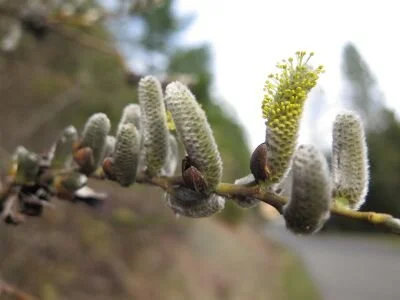
Spring in the Klamath Mountains is a celebration of flowers, capturing the magic of the region in beautiful blooms, glossy leaves, and powdery catkins. These plants provide crucial ecosystem resources, like nectar for pollinators and food for foraging, while also preventing erosion and improving soil health and water quality.
What kind of future are we leaving behind when we go? Will it have wild rivers teeming with steelhead trout and salmon sandwiched between rugged wilderness areas in the mountains? Will it have rare native plant species and life-sustaining biodiversity? Will it have people who still remember a time when fire was more of a friend than a foe, people whose grandparents taught them to wield fire for the benefit of plants, animals and people? Will it have green jobs that help rural people support their families and pass local wisdom on to upcoming generations? Let’s hope so.
In the face of uncertainty, plants continue to grow, flower, and fruit, as long as there is someone to tend them (and sometimes even when there is not). They become more than a source of nutrition, they are a symbol of resilience, a place of connection in a time when we need it the most.
Home gardens conjure images of vine-ripened tomatoes and fresh salads, but they can produce more than just salads and garnishes, and historically they have provided vital calories during times of crises. This article will review how a few different gardening writers have approached ways to maximize the amount of nutrition you can produce in your own garden.
Sometimes I worry about my social life. I work all day in a run-down old grocery store from my youth, jump around with my co-workers and community members for exercise in that same building after work, and for fun in the evenings I go to events with my co-workers, friends and neighbors under the same roof. I’m often here on weekends too…
Unthinking we have built dams in rivers, walling off hundreds of miles of critical habitat for fish and interrupting what should be a dynamic process of fluctuating flows and habitat renewal.
This past spring, a contingent of fish habitat restorationists from around the Klamath River went up to Washington State to learn from four decades of salmon habitat restoration on the Olympic Peninsula and around the Puget Sound.
In that moment, feeling all warm and fuzzy on the inside, I jumped down from the pickup truck and I know we have made a difference. We’re not just making a difference because now we have a community apple press and a whole array of tools, equipment and infrastructure to grow, gather, process and store food. We have made a difference because the way we think about food and they way we relate to food and to each other has changed.
Unlike our admirable formal educators, we informal educators do not have the same tools to evaluate success. We do not have continuous contact with students all day, five days a week, where we receive assignments and administer final exams (though we occasionally try to throw a pre and post test into the mix). Instead, true to our namesake, we rely on informal ways to evaluate our programs.
As a whitewater kayaking and rafting enthusiast, that is what dams like the ones that have tamed the Colorado River mean to me. They represent a loss of an adventure that could change one’s life and a loss of freedom that one can only feel when out in a distant wilderness.
When we compromise, we may get our needs partially met, but not completely. This is not the WKRP model of collaboration. At WKRP workshops and meetings, there is a culture of only moving forward if we are in agreement. People who work together in this process often say: we “don’t have to give up an arm or a leg” to work together. This model of collaboration represents a breakthrough.
These habitats along the margins of a stream may not look like much to a casual onlooker, but when your whole world revolves around survival against steep odds, these side-channel sanctuaries can make a big difference, and in the world according to salmon, every little bit helps.
We face a fire and fuel problem in the Klamath Mountains. Over a century of fire suppression and laws stopping prescribed burning has created a tinderbox around our communities. It is just a matter of time before these overly dense forests go up in smoke. I have a hard time viewing these trees as having sequestered carbon, as the fire reality we face makes the carbon seem pretty active, or ready to be released into the atmosphere as greenhouse gas emissions.
The Valley Fire in Middletown was described as the third most destructive on record in the state, but it was just one of several large incidents that CALFIRE managed that year. Everyone at the conference was trying to figure out what made this fire so destructive. Was it just a freak of nature, or was this going to be the new normal for fire behavior in California?
That little peach boy is why I am plunking away at my computer on this absolutely gorgeous day. To see their little faces light up as they dig in the dirt and get DIRTY..to watch kids who “don’t like GREEN THINGS” gobble down some fresh made pesto they helped grow and make…to see the amazement on her face when she sees the pea starts in the window moving towards the sunlight and exclaims “They’re moving!…They’re ALIVE!”
The catkin appears to be an example of convergent evolution; this reproductive mechanism evolved at least twice, once for the order Fagales (oaks, hazel, alder) and again for Salicaceae (willow, cottonwood).
A lot of us live remotely, surrounded by creeks and rivers, forests and mountains. Living “in” the Klamath creates strong connections. Our food and energy systems rely on it; our water, often taken from springs, is a signal of our relationship, particularly during these last dry years. Many subtle changes occurring simultaneously are easily overlooked and then there are the more dramatic changes, the fires and floods, snowstorms, rockslides, births and the deaths. All are encompassed within this river of time.
Quitting fishing so early in life remains one of my biggest regrets. But if I’ve learned anything, it’s that you don’t have to slay fish, or even live in the Klamath to love what the people and salmon who live here represent. I love to see the shadowy shapes of wild salmon spiraling around in a deep hole in the river. I love to know that they’re there. I love that they spend their whole lives trying to get home, much as the rest of us seem to do. I love the cultures that have evolved around salmon in this place. Mostly, I love that catching them is the best therapy for my brother. And maybe someday his kids will have the patience to teach me to fish and I will feel brave enough to try again.
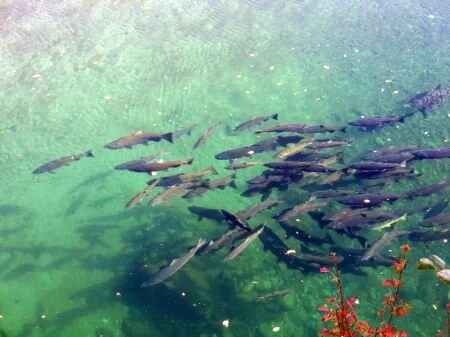
The journey of Klamath salmon is nothing short of miraculous. It is believed they swim thousands of miles by navigating the stars and smelling their way back to their home streams—all for the promise of procreation. Salmon are anadromous, meaning they are born in freshwater, migrate to the ocean, and then return to freshwater to spawn.
Remember, this was in the sixties, you were still pretty young. And I was just a child. Simplistic messages appealed to me. Your story and message were compelling but did not paint the whole picture. We know better now. Smokey, we have both grown up.